
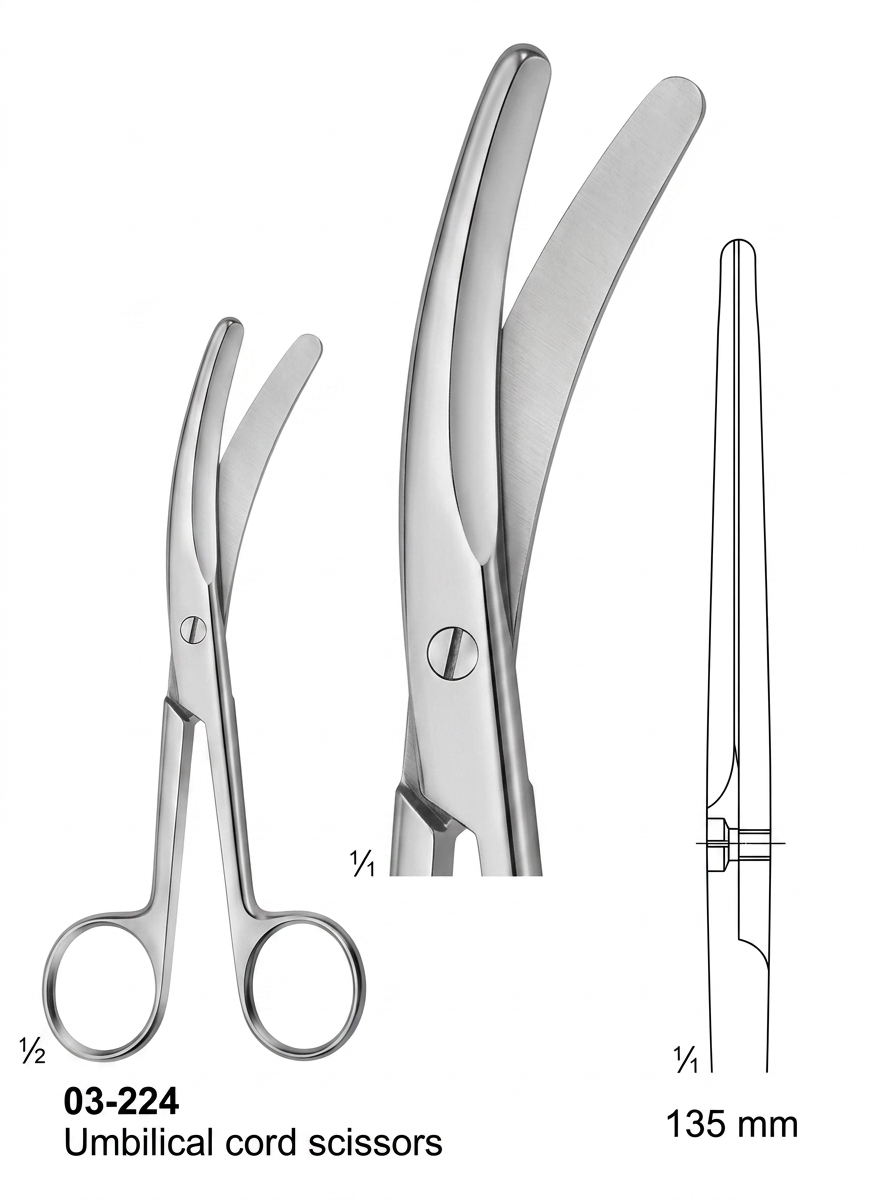
Umbilical cord scissors Scissors for Obstetrics
Intro Description Engineered for safe and efficient clamping, ligation, and transection of neonatal umbilical cords, the SIRGIKAL 03-224 Umbilical Cord Scissors for Obstetrics deliver exceptional cutting performance, structural rigidity, and hygienic reliability. Featuring specialized curved or fenestrated blade configurations crafted from certified medical-grade stainless steel, this essential delivery instrument ensures clean, crushing-preventative cuts while minimizing trauma to the newborn. Crafted with an ergonomic finger ring handle and smooth box-lock action, it guarantees structural integrity, precise mechanical control, and long-lasting performance across rigorous hospital sterilization cycles.
Product Specifications
-
Item Code: 03-224
-
Material: Certified Medical-Grade Stainless Steel (ASTM F899 compliant)
-
Configuration: Umbilical Cord Scissors for Obstetrics Pattern
-
Finish: Satin (Anti-glare) / Mirror
Key Features
-
Specialized Blade Geometry: Carefully designed serrated or fenestrated blades grip and secure the gelatinous cord tissue, preventing slipping and ensuring a clean transection.
-
Atraumatic Cutting Action: Engineered to crush and seal cord vessels cleanly, reducing the risk of neonatal hemorrhage during immediate postnatal care.
-
Smooth Box-Lock Action: Precision-machined pivot joint delivers fluid motion, uniform blade tension, and reliable tactile feedback for rapid clinical execution.
-
Autoclave-Resistant Passivation: Chemical citric passivation forms a dense chromium-oxide protective barrier, guaranteeing complete corrosion resistance across repeated high-temperature hospital sterilization cycles.
Usage
-
Obstetrics, Labor & Delivery Suites: Safe and efficient transection of the neonatal umbilical cord immediately following childbirth.
-
Delivery Suite & Nursery Utility: Essential obstetric instrument relied upon by obstetricians, midwives, and neonatal care staff requiring rapid operation, reliable safety, and dependable durability.