
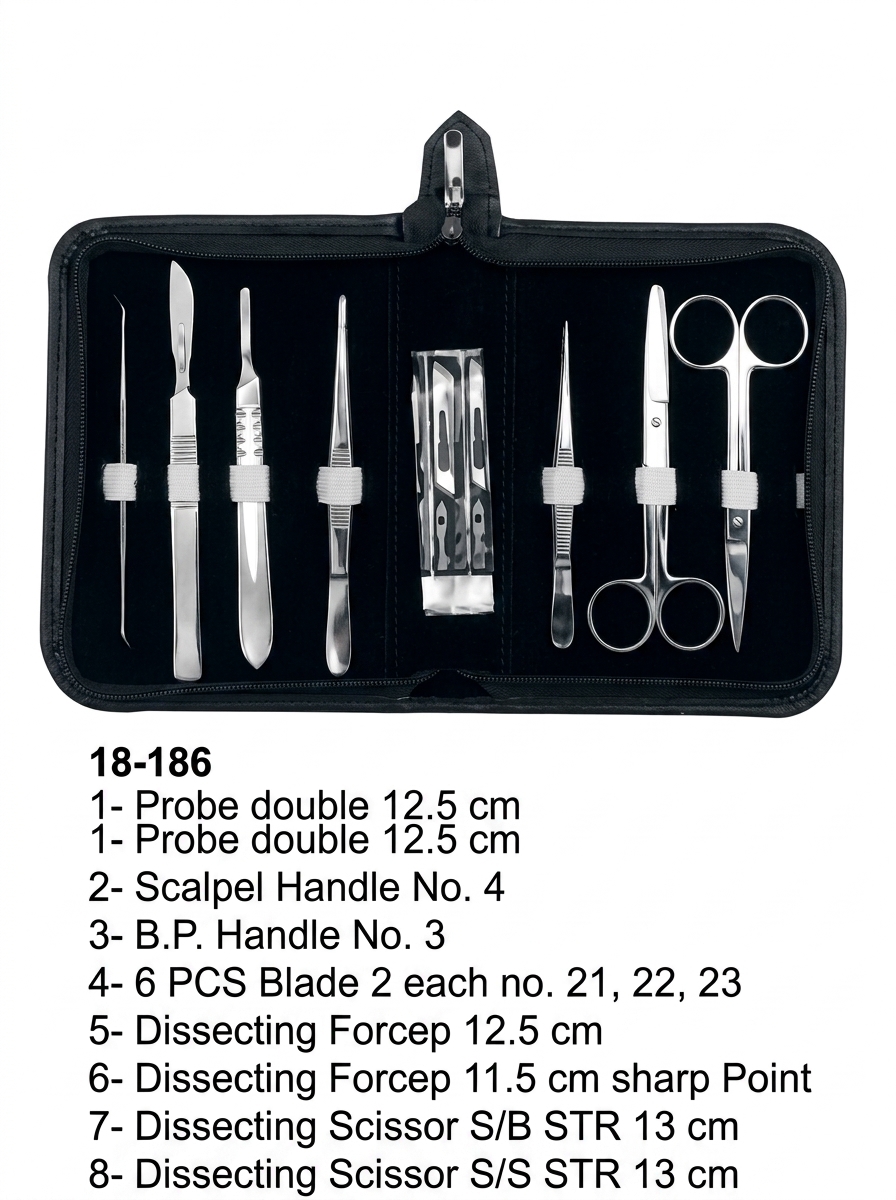
Instruments de dissection
Intro Description Engineered for precision anatomical separation, educational dissection, and biological exploration, the SIRGIKAL 18-186 Dissection Instrument delivers exceptional tactile feedback, structural balance, and fine control. Featuring a sharp, corrosion-resistant working tip mounted on an ergonomic handle, this instrument allows students, researchers, and clinicians to isolate delicate tissue layers, nerves, and vessels with absolute accuracy. Crafted from certified medical-grade stainless steel, it ensures dependable durability, sharp edge or point retention, and long-lasting performance across rigorous laboratory and training environments.
Spécifications du produit
-
Item Code: 18-186
-
Matériau : Acier inoxydable de qualité médicale certifiée (conforme à la norme ASTM F899)
-
Size: Standard Laboratory/Anatomical Length (Dissection profile)
-
Finition : Satinée (anti-reflet) / Miroir
Caractéristiques principales
-
Precision-Honed Tip Architecture: Finely shaped working end engineered for accurate separation of fascial planes and fine biological structures.
-
Ergonomic Handle Grip: Balanced shaft design provides a comfortable, steady hold to reduce hand fatigue during prolonged dissection sessions.
-
Rigid, Non-Flex Construction: High-strength stainless steel build prevents bending or deflection when applying controlled manual pressure.
-
Autoclave-Resistant Passivation: Chemical citric passivation forms a dense chromium-oxide protective barrier, guaranteeing complete corrosion resistance across repeated high-temperature sterilization cycles.
Utilisation
-
Educational & Academic Laboratories: Essential instrument for university biology, comparative anatomy, and medical student training courses.
-
Pathology & Research Facilities: Delicate tissue separation, specimen preparation, and exploratory anatomical dissection.
-
Laboratory Utility: Versatile instrument suited for general biological handling and scientific investigative workflows.